
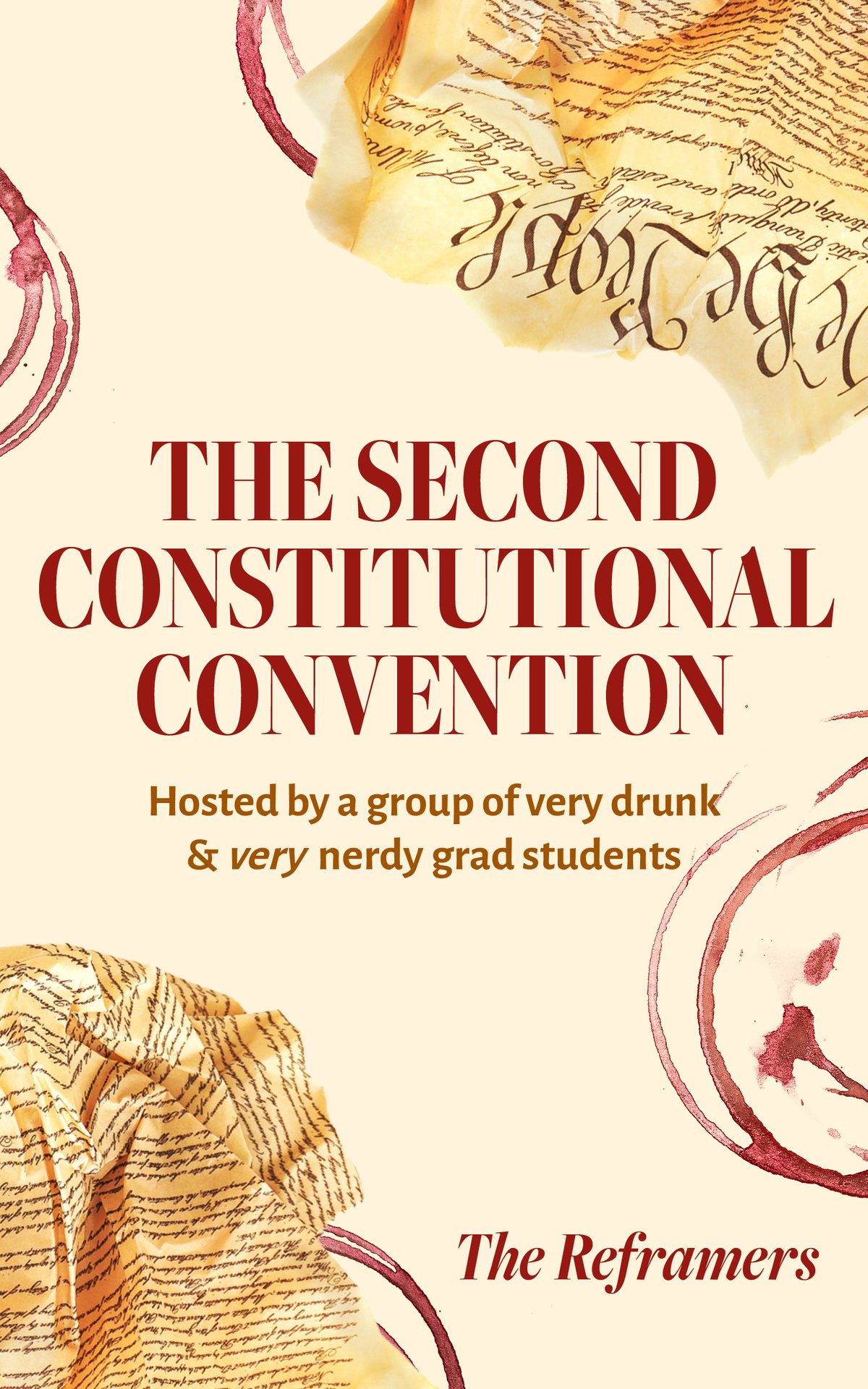
Mr. Book just finished The Second Constitutional Convention: Hosted by a Group of Very Drunk & Very Nerdy Grad Students, by The Reframers.
Mr. Book went into The Second Constitutional Convention included a discussion on how a new constitutional convention would be organized, how it would operate and what procedures it would follow before getting into the substance. Instead, the authors wisely avoided getting bogged down in procedural details and went straight to the far more interesting question of what a redesigned American government should actually look like. It turned out to be a much better approach than the one he had anticipated, resulting in an outstanding examination of how our government could be restructured and improved.
Mr. Book knew that the book would examine Roman and British history in addition to American history. Normally, he has very little interest in reading about history outside the United States. But the authors quickly demonstrated that they could make even those subjects fascinating. Their examination of earlier systems of government and the problems they encountered provided an excellent foundation for their proposals on how to build a better American government.
The book’s central argument is that the problems with government go much deeper than the particular individuals who happen to hold office. Throughout history, political systems have depended on people voluntarily respecting constitutional limitations, even when violating those limitations would advance their own interests. The authors argue that this is a fundamental weakness in constitutional design. Rather than expecting politicians to behave honorably, governments need to be structured so that pursuing their own political interests also encourages them to govern responsibly.
The history of the Roman Republic provides an excellent illustration of this problem. The Romans established a system with checks and balances, limits on political power and safeguards against the emergence of another monarchy. But as Rome expanded, its political leaders increasingly found ways to circumvent those restrictions. Measures intended to solve immediate problems created new opportunities for ambitious individuals to accumulate power. Eventually, the constitutional system was unable to prevent the destruction of the Republic.
The authors bring this same approach to their examination of British and American history, showing how political institutions evolved and how their weaknesses became apparent over time. Rather than simply treating the American Constitution as a remarkable achievement of the Founding Fathers, the book examines the limitations of the system they created and the consequences of leaving those problems unresolved.
The second half of the book turns from examining the failures of earlier systems to proposing solutions. One of the most important subjects is the American electoral system. The authors argue that the traditional method of electing candidates encourages a two-party system in which voters frequently feel compelled to support the lesser of two evils rather than the candidate they actually prefer.
Their proposed solution includes ranked-choice voting, which would allow voters to rank candidates in order of preference. If no candidate receives a majority of first-choice votes, the last-place candidate is eliminated and those votes are redistributed according to the voters’ next preferences. The process continues until a candidate receives a majority. The authors argue that this would make third-party candidates more viable, reduce the spoiler effect and encourage candidates to appeal to a broader electorate.
The book also examines the incentives that encourage negative campaigning. Under the existing system, candidates can benefit from discouraging their opponents’ supporters from voting. But in a ranked-choice system, candidates would have an incentive to appeal to supporters of other candidates in the hope of receiving their second-choice votes. The authors’ larger point is that changing the rules of elections can change how politicians behave.
Another particularly interesting proposal is compulsory voting. The authors point to Australia’s experience, where voting has been mandatory for approximately a century. Their argument is that when virtually everyone participates, politicians can no longer rely on winning elections by maximizing turnout among their own supporters while discouraging participation by their opponents’ supporters. Instead, they must appeal to a much broader cross-section of the electorate.
The book also addresses the structure of Congress, congressional oversight and the federal judiciary. The authors challenge the assumption that longstanding features of American government should be preserved simply because they are familiar. For example, they point out that the Supreme Court’s current membership of nine justices is not a constitutional requirement. Congress has changed the size of the Court numerous times throughout American history.
One of the book’s distinctive features is its humor. Despite dealing with serious subjects involving constitutional government, political instability and the collapse of democracies, the authors frequently use jokes, sarcasm and entertaining comparisons to make their arguments accessible. The result is a book that approaches constitutional reform very differently from a conventional academic examination of the subject.
Ultimately, The Second Constitutional Convention is not simply a book about what is wrong with American government. It is an ambitious attempt to explain why those problems exist and how changing the underlying structure of government might address them. Its central message is that constitutional reform should not depend on the unrealistic expectation that politicians will consistently put the public interest ahead of their own ambitions.
Mr. Book gives this book an A+. Goodreads and NetGalley require grades on a 1-5 star system. In Mr. Book’s personal conversion system, an A+ equates to 5 stars. (A or A+: 5 stars, B+: 4 stars, B: 3 stars, C: 2 stars, D or F: 1 star).
This review is intended for posting at NetGalley, Goodreads and Mr. Book’s Book Reviews.
Mr. Book finished reading this book on October 19, 2026.
The book is scheduled to be published on November 6, 2026.
Thank you, Whitehorn Media Group, LLC, for providing this book for review consideration via NetGalley in exchange for an honest review. All opinions expressed are Mr. Book’s own.